

Choosing a Case for a Peeled Banana Squishy
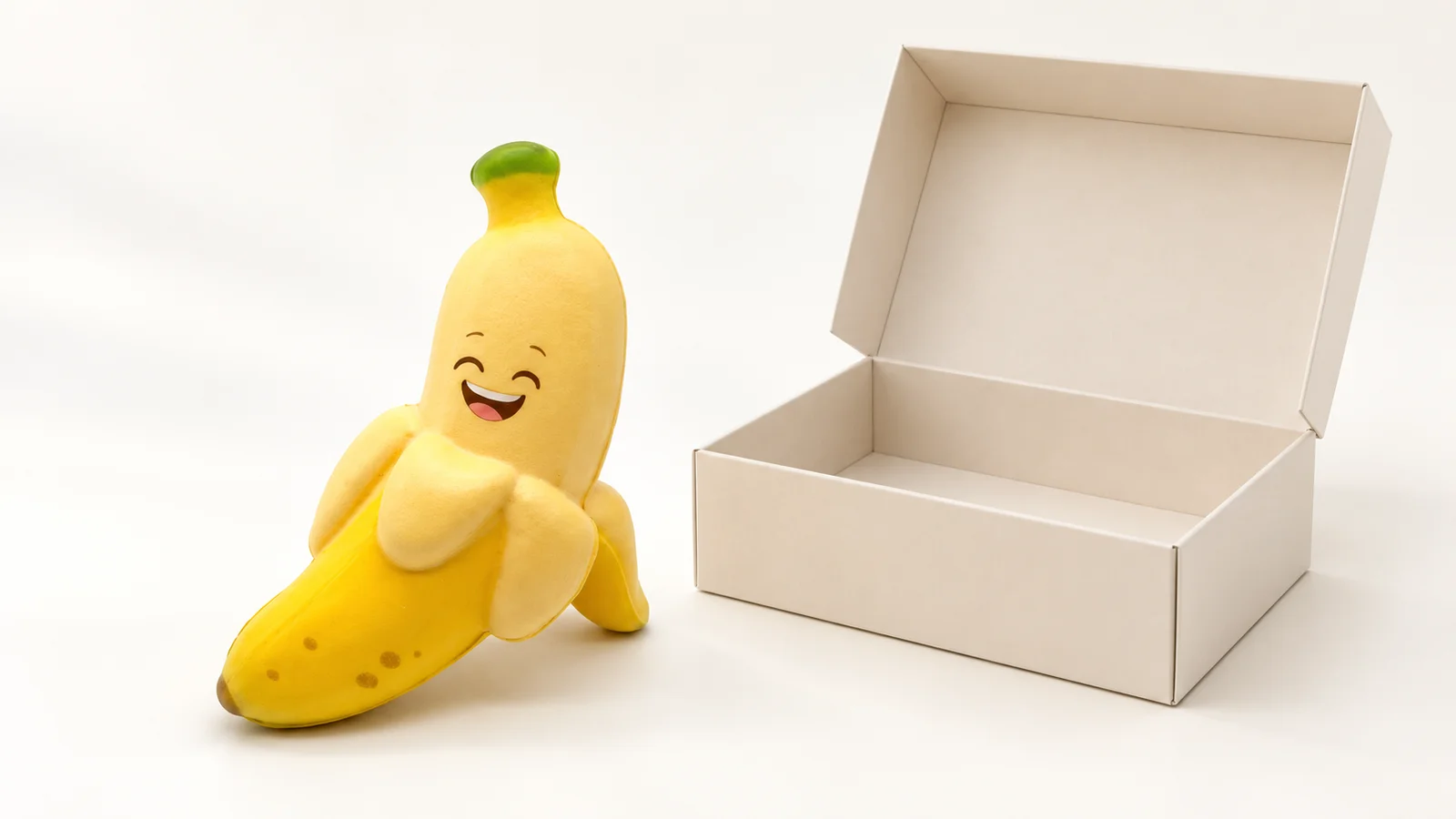
AI-generated illustration based on the product photo. The box is illustrative and does not establish fit.
Choose a case for a peeled banana squishy by checking its opening and its usable interior separately. Include the whole toy with every peel petal resting naturally. Measurements can help you shortlist a case, but confirm the fit with the actual toy: it should go in without reshaping it, and the lid should close naturally.
Use the Smiling Peeled Banana Squishy product page to check that you are measuring the same design. Squishyuy describes it as a bright yellow banana squishy with three peel petals and a printed smiling face.
Record the banana’s full outline
Put the banana in the position you would like it to rest inside the case. Measure its full length, its widest span across the petals, and its height in that position. Use the same unit throughout your notes, and include a quick sketch or a photo so you can remember which way it was facing.
Keep the petals in their natural position while you measure. Do not pull them outward, fold them inward, or squeeze the body to produce a smaller number. The outline you record should match the toy you intend to place inside.
If you change the banana’s orientation later, check the outline again in that position. A length recorded with the toy lying one way should not be combined with a height taken in another.
Check the opening before the space inside
Open the candidate case fully and examine the route into it. Compare the entire banana outline with the narrowest part of the opening you would need to pass through. Include any rim or closure that remains in the way when the case is open.
Then measure the usable space inside, with the lid and base in mind. If part of the lid projects into the compartment when closed, account for the space it occupies.
Keep these observations separate in your notes:
| Check | What to record for this candidate |
|---|---|
| Banana outline | Full length, widest petal span, height, unit, and orientation |
| Route through the opening | Narrowest usable opening and anything in the insertion path |
| Space inside | Usable interior with any space taken up by the closed lid |
| Actual placement | Whether the whole toy went in without folding or squeezing |
| Closure and backpack space | Whether the lid closed naturally and the closed case fit the intended space |
Treat the measurements as a way to narrow your choices. A few dimensions cannot show every turn or obstruction along an insertion path. Leave the placement and closure entries unfinished until you have tried the actual case.
Try the actual fit before packing your backpack
Bring the banana to the open case in the position you recorded. Gently place it inside, watching the petals as well as the body. If the opening requires you to tuck a petal in or compress the toy, stop and choose another candidate.
Once the whole banana is resting inside, lower the lid slowly. Check whether it meets the toy before it reaches its normal closed position. Do not use the latch or zipper to pull the case shut over the banana. If closure changes the toy’s shape, choose a different case or reassess an orientation that leaves the full outline uncompressed.
Write down what happened with that particular toy and case. A note such as “petal meets the rim before the body enters” gives you a specific reason to reject the candidate. Only record a successful fit after the actual placement and closure check. These observations do not test scratch or impact protection during travel.
If you also want to carry a Creamy Butter Stick Squishy, start a separate outline record. Squishyuy describes its butter design as a rectangular pale-yellow bar. For a Plump Yellow Duck Squishy, include the bill and belly in its own check. Squishyuy describes its duck as a sitting duck with an orange bill and round belly. Try the intended contents together before recording a shared case as a fit.
Finally, put the closed case into the backpack space you plan to use. Check that you can close the bag around it without forcing it into position. Record the case you chose and the orientation that worked, so the next packing attempt starts from that same arrangement.